THE JURY IS STILL OUT as to whether “galapágo” is an old Spanish word for “saddle” or for “tortoise” which the saddles resembled. Either way, the Galapagos would be nothing without the giant tortoises that gave the islands their name.
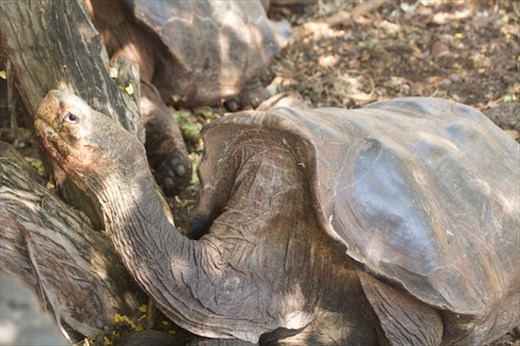
Saddle-Backed shells allow for a higher reach
It is believed that the tortoises arrived in the Galapagos two to three million years ago, probably by floating on rafts of vegetation. This accidental voyage must have occurred many, many times with tortoises landing on different islands. Even on the same island, lava flows separated populations where their unique traits enabled them to survive, eventually becoming separate species.
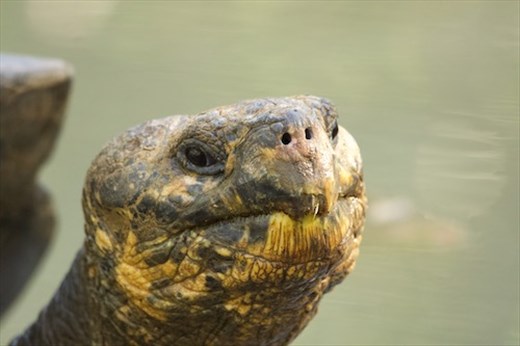
Galapagos Giant Tortoise
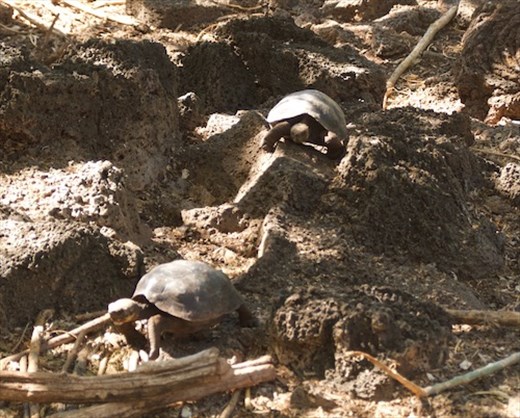
The New Generation: Fausto Llerena Breeding Center
As many as 200,000 to 250,000 giant tortoises comprising fourteen species once roamed the Galapagos. Only eleven species remain today with about 15,000 individuals, but captive breeding programs are in place to increase the numbers. Tortoises with dome-shape shells are good at grazing and have been successful on the older humid islands with lots of vegetation. They couldn’t compete on the younger, drier islands with tortoises whose saddle-backed shells have an upward curve to the front of the carapace that allows them to stretch up to higher growing plants.
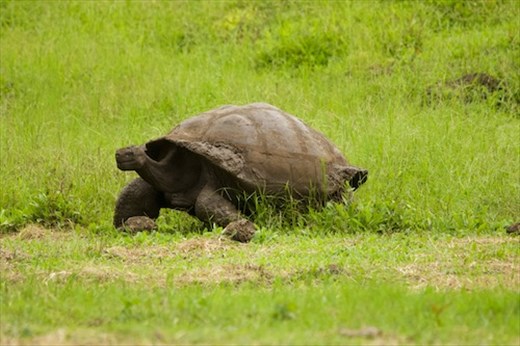
Dome-shaped shells are found on grazing tortoises
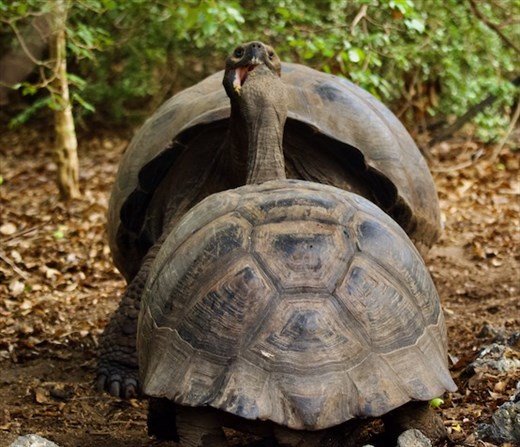
A Battle of Wills . . . and Shells
The most famous Galapagos Giant Tortoise, Lonesome George, passed away at the ripe old age of 110 just a few years after we saw him. His mounted body is on display on the islands, courtesy of the American Museum of Natural History in NYC.
