One of the easiest ways to travel more responsibly is to shop more
responsibly. Whether you’re buying ingredients at a local market to cook a
meal, gifts for family or friends, or mementoes for yourself, all you need to
do is follow our six tips to shopping more sustainably when you travel.
Travelling more
sustainably and more responsibly was one of the main aims of our yearlong grand
tour of the world we called Grantourismo,
an experiment in slow travel, local travel, experiential travel, and ‘giving
back’, which we undertook with the support of HomeAwayUK.
Our starting
point was ‘slow travel’ and spending longer in places (two weeks in each
destination) rather than flitting through in a few days – which is why it made
sense to swap hotel rooms for holiday rentals. Holiday rentals are often second
homes rented when owners aren’t using them or dedicated properties set up for
travellers who like settling in for a while. Generally located out of tourist
zones in everyday neighbourhoods, they give people more opportunities to travel
in a more eco-friendly manner by consuming less energy, recycling waste, and
contributing more to local businesses.
How and where we
spent our money was our next focus. Food, music, fashion, art, craft, and
design all provide ways into understanding a culture and getting beneath the
skin of a place. In each place we stayed we learned something about the local
cuisine, shopped the local markets, and cooked ‘at home’. We weren’t going to
travel the world for a year without buying mementoes or replacing some clothes.
And as we’re both passionate about art, crafts, design, and music, we acquired
a little of each along the way. Over the course of the year we adopted the
following rules that we now make it a habit to travel – and shop – by!

1. Buy Ethically
Few travellers, especially female ones, leave the French capital without taking
away some home-grown fashion. In Paris, we stayed in an apartment on the lower
slopes of Montmartre where I met Christelle Bonnivard in her chic boutique Mademoiselle Bambû (pictured above).
After being inspired by the beautiful clothes she saw at an Ethical Fashion
Show, Christelle gave up an advertising career to open her shop where she only
sells ‘ethical fashion’ – clothes, jewellery and accessories made by small
independent designers who only use materials whose origins they know. “The
products must respect the environment, respect human beings, and be 100% biologique
(organic),” Christelle told me. “In France we have a strict certification and
standards system – the tags should say where the product was made, what it’s
made from, and whether it is organic cotton or 100% biologique.”
TIP: To ensure you’re buying things
that are ethically made, read the information on the labels and tags.

2. Support Fair Trade
‘Fair Trade’ goods are
ethically made products that come with more guarantees. In Bali, we could have
bought souvenirs at the myriad markets, but we had no idea where they came
from, whether child labour was used, and whether workers who made them were fairly
treated. Instead we went to Fair Trade shop Threads of Life in Ubud, which sells handmade textiles and handicrafts (pictured above). Fair
trade products are produced and sold according to World Fair Trade Organization
principles that require that education, training and employment opportunities
be provided, people be paid fairly, and production be environmentally
sustainable. Threads of Life works with traditional weavers in villages too
remote to benefit from tourism, helping to train them, feed their families,
educate their kids, maintain their traditions, and enable their communities to prosper
and grow. So by shopping at Fair Trade businesses we’re helping too.
TIP: Look for stickers on shop windows
and certificates on walls confirming Fair Trade status.

3. Go Organic & Eco-Friendly
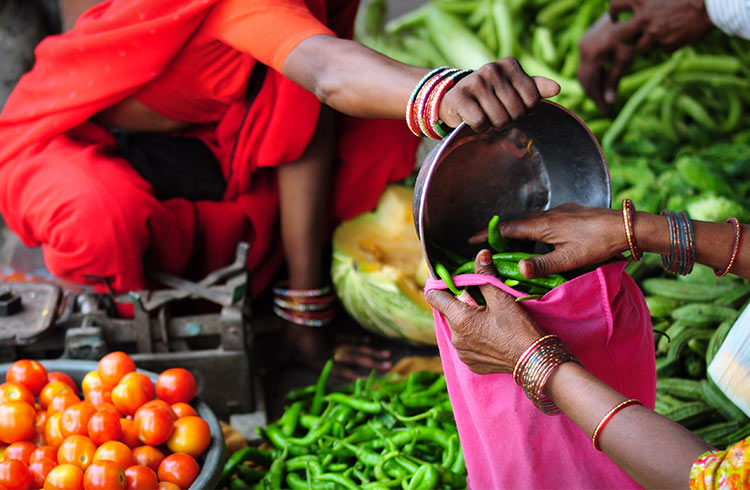
In every place we
stayed we sought out farmers markets and ‘green’ markets for local, seasonal, organic
produce, which leaves a smaller footprint than imported products that have been
flown in or travelled some distance. For souvenirs and gifts, I tried to go beyond
the usual recycled paper and soaps. For instance, in Venice’s touristy Rialto,
steps away from stalls selling Chinese-made trinkets, I discovered Pied à Terre
selling colourful brocade, silk and velvet slippers, inspired by those that peasant
farmers who couldn’t afford leather shoes once made from recycled rags, jute
seed bags and bicycle tyres; desperately poor, they went to Venice to sell their
soft-soled shoes to gondoliers. Pied à Terre makes their version using recycled
tyres and fabrics. In Venice, I also found Dietro Langolo, owned by architects Federica Serena and
Sylvia Saltarin, which sells eco-friendly fashion, accessories and design
objects created from recycled materials, including silicon, electric cable, fire
hoses, and candy wrappers!
TIP: Look
beyond the supermarket and souvenir shops for organic produce at farmers
markets and interesting eco-friendly stores for special mementoes.

4. Buy Local and Buy Direct
In San Miguel de
Allende, I found styish Ave María (pictured above), specializing in cool,
quirky, kitsch Mexicana, owned by local girl Giovanna Canela Miranda.
Everything, from the t-shirts and handbags to art and interior design objects are
‘hecho en Mexico’ or ‘made in Mexico’. Giovanna proudly told me she designed
many of the things herself which she commissioned Mexican artists to make, or
she travelled around Mexico sourcing things directly from Mexican designers and
artisans. In a town like San Miguel, which has a large expat population and many
foreign-owned businesses, buying local is essential. By buying locally made
products from local business owners, you know what you’re buying, you’re
supporting local designers, craftsmen and artists; and you’re helping create demand
for local products in a climate increasingly favouring cheap, mass-produced trinkets
from China – yes, even in Mexico! Locals also re-invest profits into their
community, whereas foreign business owners tend to send it ‘home’, so you’re
helping ensure places have a distinctive local character, the kind of character
shaped by quirky one-of-a-kind shops like Ave María.
TIP: Don’t be afraid to ask staff who owns the shop and where their
products come from.
5. Keep Traditions Alive
In Céret, at the foot
of the French Pyrénées, we noticed colourful stripes brightening everything
from shop-fronts to feet (espadrilles!). Similar to British designer Paul
Smith’s trademark lines, the distinctive candy-stripes are of Catalan origin,
famously starring on Les Toiles Du
Soleil, or The Cloth of the Sun, produced at nearby Saint Laurent de
Cerdans for some 150 years. Once, the entire village was devoted to the
textile’s creation by traditional techniques, but as machine manufacturing
expanded business declined. Fortunately there’s been a resurgence of interest in
the fabric thanks to three designers working under the umbrella ‘Made in Céret’ :
Raphaelle Reixach makes charming Catalan sailor jackets, Jerome Perez decorates
lamps and upholsters furniture, while Coralie Scarnato creates sunhats, bags,
placemats, napkins, and table runners on a sewing machine in her shop. What
makes Les Toiles Du Soleil
special, Coralie told me, is its strength and durability due to it being
tightly woven on old looms, and it’s fade-proof thanks to a traditional dying
process. I left with some colourful placements, knowing not only did I have a
uniquely Catalan souvenir, I contributed to the revival of a traditional craft (pictured at top).
TIP: Wherever you are seek out traditional
crafts or contemporary applications of traditional techniques; ask questions.

6. Choose Vintage Over New
As we travelled the globe, I spotted vintage shops springing up everywhere,
from Buenos Aires to Berlin. For fashionistas, buying vintage clothes is about
creating an individual style statement from rare old pieces unlikely to be seen
on anyone else. Vintage is increasingly hip and the charity shops around the
world that have de-cluttered their spaces and dusted their shelves in cities
like Edinburgh reflects this. There, Barbara Williams, manager of Save the
Children’s Mary’s Living and Giving Shop (pictured above), told me how after a
stylish revamp by celebrity retail-makeover guru Mary Portus, the shop is
crowded with customers daily, as are others in Edinburgh. I love buying clothes
as souvenirs so whenever I wear them I’m reminded of the place I discovered
them. But what I love about buying vintage when I travel is that if it was rare
in the place I bought it, it’s highly unlikely I’m going to see anyone wearing
it elsewhere. But more importantly, I’m recycling something old, which is far
better than buying disposable fashion.
TIP:
Ask locals to point you toward charity shops; vintage stores are found in
hip neighbourhoods rather than tourist areas.
Related Articles:
Top 10 Emerging Green Destinations
Peru: Empowering Women through Tourism
About the Author
Travel writer Lara Dunston and her photographer husband Terence Carter
have authored and updated some 40 guidebooks and had hundreds of travel
articles published on websites and in magazines and newspapers around the
world, from National Geographic Traveler to Wanderlust. They recently completed
a year of sustainable travel, sponsored by HomeAwayUK, which they chronicled on
their blog Grantourismo.
About WorldNomads.com
WorldNomads.com keeps
you travelling safely. Whether you’re off for a long weekend, looking
for the ultimate adventure or living the nomadic dream, you’ll stay safe
with Travel Insurance you can buy online, anytime, and the latest travel safety advice. We’ll also help you share your journey with a free travel blog, flirt in over 25 languages with our free language guides, have an experience of a lifetime on a travel scholarship and donate to a local community development project through our Footprints program.
WorldNomads.com - an essential part of every adventurous traveller's journey.