April 9
I awoke to news that my first planned side-trip to an ancient monastery outside of Tbilisi was cancelled due to roadblocks throughout the capital. The anti-government protests were in full swing, but people were reportedly remaining quite peaceful and no violence had broken out. Though cognizant of the August 2008 clashes with Russia and South Ossetia, I was curious enough to venture towards Parliament to check things out for myself.
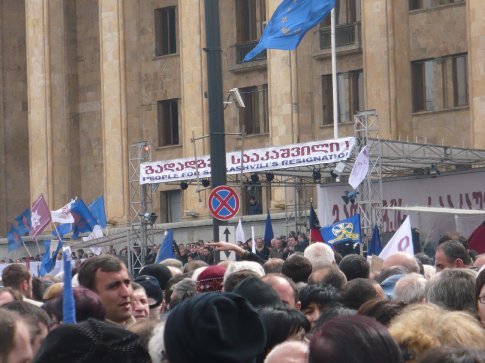
It wasn’t until I had actually reached the protest on Rustaveli Ave that I noticed any signs of activity. The streets leading up to Rustaveli were functioning perfectly normally as if anti-government protests happen every day (which, arguably, they do here in Georgia, in one form or another). I must say, when I happened upon the massive crowd, tens of thousands strong, I had expected a more palpable, electric tension – the type that makes your skin crawl, tightening its grip around your neck in anticipation of the air exploding at any moment. Instead, I was greeted by young parents pushing their babies in strollers, elderly men chatting over steaming cups of coffee, and groups of smiling youth walking slowly and calmly down the road. Even the ever-resolute babushkas snaked their ways through the crowds, selling their cupfuls of shelled sunflower seeds just like any other day. Lots of people carried flags in support of one of the many different opposition parties or simply of their shared nation. Some gathered in front of churches, others climbed trees for a better view of the packed Parliament steps, and still others clutched onto friends while balancing precariously on large monuments. They were all there, however, for a shared goal: to oust their president on an already historic day.
On April 9, 1989, after years of increasingly nationalistic sentiments among Georgians, Soviet troops massacred 20 hunger strikers who were among a non-violent crowd of 150 000 protesting against USSR rule. The waves of outrage that swept through Georgia thereafter catalyzed her eventual declaration of independence from the USSR in 1991.
Following Georgia’s independence, Russia continued to exert political influence, particularly in the breakaway regions of South Ossetia and Abkhazia. Russia’s aim was to encourage these regions to declare independence from Georgia and thus ally with the motherland; she did so by supplying the residents of Ossetia and Abkhazia with things like medical care, easy trade routes, weapons, and even Russian passports.
The exact events leading up to the outbreak of the short-lived but harsh war between Georgia and Russia/South Ossetia/Abkhazia in August 2008 are unclear. The South Ossetians and Georgians exchanged military attacks, but both sides blame the other for firing first. Russian troops then invaded with arguably unnecessary force; many people on both ‘sides’ of the conflict died and the international community was stunned by this outright display of aggression, particularly from Russia. Still no one is sure of what exactly happened, but it is at least clear that the vast majority of those affected were innocent civilians.
Since then, President Mikheil Saakashvili has come under increasing political fire from his constituents and opposition parties for corruption and how he (mis)handled the war with Russia. The current protest that began on April 9, 2009, was staged by the various opposition parties to demand Saakashvili’s resignation. The protest organizers added an interesting twist by scheduling it to coincide with the 20th anniversary of the Soviet massacre of the hunger strikers in the same location. Saakashvili was thus forced into the ironic position of being expected to pay tribute to the hunger strikers (whose actions catalyzed Georgia’s independence) and then face tens of thousands of his constituents trying to oust him from power.
Note: The protests are still ongoing in Tbilisi and have mostly remained peaceful, except for a clash on May 6th between police and opposition supporters. Unfortunately (though predictably), Saakashvili has refused to step down but offered to hold negotiations with the opposition parties. There is still a political stand-off in the Georgian capital and tensions recently were heightened around an alleged military coup at a base near Tbilisi, which Saakashvili blamed on Russian provocation in response to planned NATO trainings at the base. Again, it is unclear what happened or will happen in little Georgia, but it is certain that she is still a target in Russia’s sights, which is never an enviable position to be in…
