Without a doubt the best way
to experience the lush, rolling green countryside Ireland is renowned for is by
car – or bicycle. The freedom of travelling through the country by car, rather
than train or planes, enables tourists to stop, walk in the fields, stop at
Celtic ruins and discover tiny Gaelic speaking towns off the tourist map.
Vehicles hardly approach the
high speeds of drivers on autobahns in west European countries such as Germany,
France and Italy but there are other dangers and risks travellers should be
aware of. Likewise with boating and cycling.

Driving tips for Ireland
Ireland is a relatively small country but traversing from east coast near Dublin to the spectacular harbour city of Galway in the west, is not a quick journey due to the state of the roads. They tend to be narrow, two-lane roads that can be jammed with traffic – human and herds of cattle in the rural regions!
For those not used to it, driving in
Ireland is on the left! Become accustomed to this before you hit some of the
more treacherous roads in the countryside and especially near cliffs. The roads
are at times narrow and made worse by the rain, mist and fog – in
ANY season.
Throw in masses of cows and sheep and it can be challenging.
The main tip with driving through Ireland
is to take it easy. Locals are used to the roads and may drive faster but don’t
use that as a cue to increase your speed. Though the further from the cities
you get, you’ll find the pace all round is very leisurely
Shift Yourself
When hiring a car, be aware that most are
manual (stick shift), not automatic transmission. And don’t expect you will get an auto just
because you reserved one. There are a limited number available. With a bit of
Irish luck you will, but be prepared you may need a hasty lesson in manual
driving if you’re not used to it.
Get Lost!
It’s highly recommended to get a map. Some
rental companies may also hire out GPS’s. It’s not hard to get lost as there
are many little country roads but that is part of the fun of Ireland – discovering
places you have never heard of and engaging with the charming locals. In fact,
asking directions from a local could end up being a half hour conversation
about your Irish lineage and who they know with the same surname!
Roads can be quite primitive in comparison to the four lane highways at home. And often they’re not well marked. And in night it can be pitch black without any streetlights in rural areas so it may be wiser to travel during daylight in unfamiliar and remote parts of the country. And know the upcoming towns and landmarks (have a map!) as signs can be few and far between in some areas.
Stay Sober
Just because drinking is a national
pastime, doesn’t mean drink driving is acceptable. The legal blood alcohol
limit is 0.08 and it is an offence to drive with a reading above that. Like any
country, observe their local laws.
Fill The Tank
Petrol is easily found at service stations
(though it’s not cheap) and it’s wise to always keep at least a third of a tank
full. Reason being many service stations close on Sundays, and in remote rural
areas you could travel for long stretches without being able to fill up. And
some don’t take credit cards so have cash handy.
Keep Left
There seem to be some cavalier attitudes to
overtaking on two lane highways. Irish drivers will often go right down the
middle of the road to pass another car, regardless of oncoming traffic in the
other lane. The oncoming traffic; as well as those being over taken, are
expected to drop to their left while the passing car goes right down the middle,
making it seem that the overtaking car has right of way!
As mentioned, drive at your pace if you are
nervous about the road conditions and if you are driving slower than others, keep
to the left side of the road and use the shoulder (if there is one). If you are
driving much slower, it’s not a bad idea to use the hazard lights while as far
left as you can drive.
Signposts & Road Signs
When there are road signs, you will notice
that all place names are written in English and in Irish (Gaelic).

This is
generally considered quaint by travelers until they find themselves in a
Ghaeltacht region. These are regions where Irish is the dominant language and
all signs are written in Irish only and all people speak Irish, though most
have a very good command of English.
Trying to decipher written Irish is impossibility.
The words do not resemble English at all and therefore it can be quite easy to
get lost. The Irish language is making a comeback and is now a compulsory
school subject, spreading the areas that are in Ghaeltact regions. Currently
they are found in Kerry, Galway, Mayo, Meath, Cork, Donegal and Waterford.
Cycling Tips
For
those who seek to really experience the Irish countryside, cycling can be a
wonderful way to do it. However it is not without it’s pitfalls.

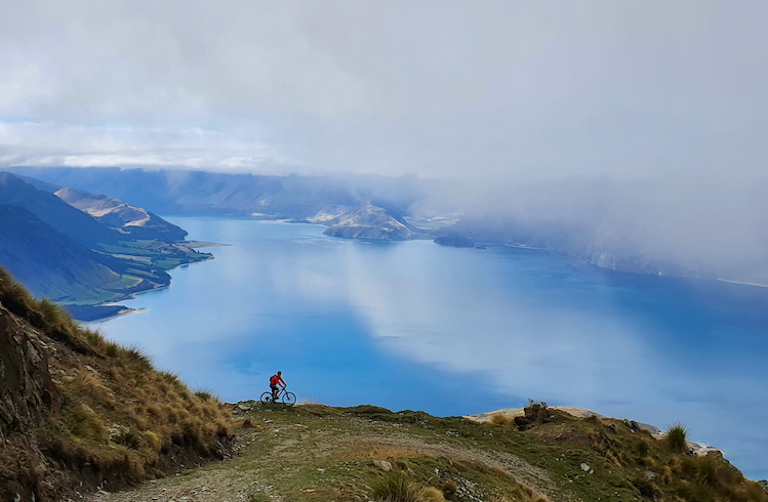
(Either an Irish country idyl, or the rider has fallen off the mountain - you decide)
Don’t
assume from the idyllic postcards and brochures it’s a easy ride. Many of the
tracks have serious hills and can be dotted with large potholes. And as
pointed out above, many roads are narrow do not have shoulders or cycle lanes.
You may find the where the bitumen stops abruptly, old stone walls or stiff
hedges crops start, leaving no room to move. The safest option is to stay as
far left as possible, keeping in mind the traffic can be of nightmare proportions.
And if
you want to see the magnificent views Ireland is renowned for, be mindful they
are usual very high and that means and you have to get yourself and your bike
up there. Plan your cycling trip carefully as what seems a short distance could
take much longer due to the state of the roads and how they rarely seem to go
from A to B in a straight line.
Weather Prepared
One of
the most important factors of any cycling trip is the weather, and in Ireland
it can be temperamental with four seasons in a day not uncommon. It may start
off warm and dry with the sun shining, yet descend into a grey misty and cold
hell an hour later.
Wear layers and prepare for all inclement conditions. It is
wise in summer to carry a flashlight if you get stuck cycling at night. While
the summer days are long, light until 10pm and later depending on where you
are, the darkness is total, making cycling dangerous. Not only potholes, but
apparently roving badgers are a hazard too!
Another
handy tip is to take a tool kits to fix punctures (which more than likely will
happen) and once again, a very detailed map that shows inclines.
Off Your Bike
And
while the countryside is lovely to cycle through, Dublin isn’t. Like many
cities kamikaze courier cyclists weave through traffic and pedestrians with
skills that rival stuntmen and women. Dublin is much better experienced on foot
for tourists.
Boating and Swimming Tips
While it seems amusing to
think of travelling to Ireland and swimming at all, especially when coming from
warmer climes, it does happen. There are even surfers who travel to the isle to
experience the breaks. However many Irish beaches, rivers and lakes are not
supervised. And those that are normally only during “office” hours” in summer
(while anyone would want to swim in Ireland in winter is a question that cannot
be answered in this blog).

(A few brave souls)
What can be more dangerous
than swimming in surf, is swimming in lakes and rivers in Ireland. As well as
strong, unpredictable and to the inexperienced eye, unseen currents, inland
waterways can plunge suddenly in depth and have all sorts of vegetation,
branches and rubbish underneath that you could get snagged in. It’s advisable
not to swim at all as fatalities are increasing.
And you are more likely to
encounter trouble with idiots in motorboats than any dangerous marine sea life.
There has been a proliferation of inexperienced motorboat and jet ski riders
travelling at high speeds on waterways. And the restrictions on small vessels
are non-existent. Stay out of their way is the best advice.
Climbing Tips
The Cliffs of Moher in County
Claire may be magnificent, but it’s not suggested you climb them. Nor other
rock faces along the spectacular west coast which are steep and high and treacherous.

Even climbing low level cliffs has resulted in people being dragged out to sea
by freak waves. It’s one thing to look over a cliff and admire the view, than
to attempt to navigate it. It begs the question “what for”?.
Related Articles
About WorldNomads
WorldNomads.com keeps you travelling safely. Whether you’re off for a long weekend, looking for the ultimate adventure or living the nomadic dream, you’ll stay safe with Travel Insurance you can buy online, anytime, and the latest travel safety advice. Learn how to flirt in over 25 languages with our free language guides and have an experience of a lifetime on a travel scholarship. We'll also help you share your journey with a free travel blog, get answers from other nomads to all of your travel questions (try the new 'Ask A Nomad' iPad app and donate to a local community development project through our Footprints program.
WorldNomads.com - an essential part of every adventurous traveller's journey.